Physionym
Me and my girlfriend were driving past the Hillcrest Convalescent Center in Durham and I remarked that 'convalescent' was one of those words that I often messed up, because it doesn't sound like what it means. 1 I think in my mind it feels like convulse or convoluted, neither of which feel sufficiently healing. She offered up some examples of the opposite, of words that do sound like what they mean: guttural, lugubrious, bulbous. Then she asked me what the name for that was.
I had no idea, but it turns out that a lot of people have a similar question!
Wrong answers
Some people point to onomatopoeia, for words like buzz, hiss, meow, or woof, 2 Which is guau, guau in Spanish! I wonder if dog noises in different languages depend on the most common breeds to those areas. all vocal imitations of the sound associated with it. These mostly have the same quality as what we're looking for, but it seems like a subset: nothing bulbous makes the sound 'bulbous'. Some people point to autological words, which are words that express a property they express: stuff like terse or unhyphenated, but also stuff like pentasyllabic or sesquipedalian. These are also apt, but in a way that's different from what we're trying to describe.
Some people point to the 'Bouba/kiki effect', 3 This used to be takete–maluma, but a 2001 study used bouba and kiki and that's what's gone viral ever since. where you can predict people's associations of sounds to shapes. The famous shapes, if you haven't done it before, are below: which would you call 'bouba' and which would you call 'kiki'? You can hover over the spoiler text to see which is which.
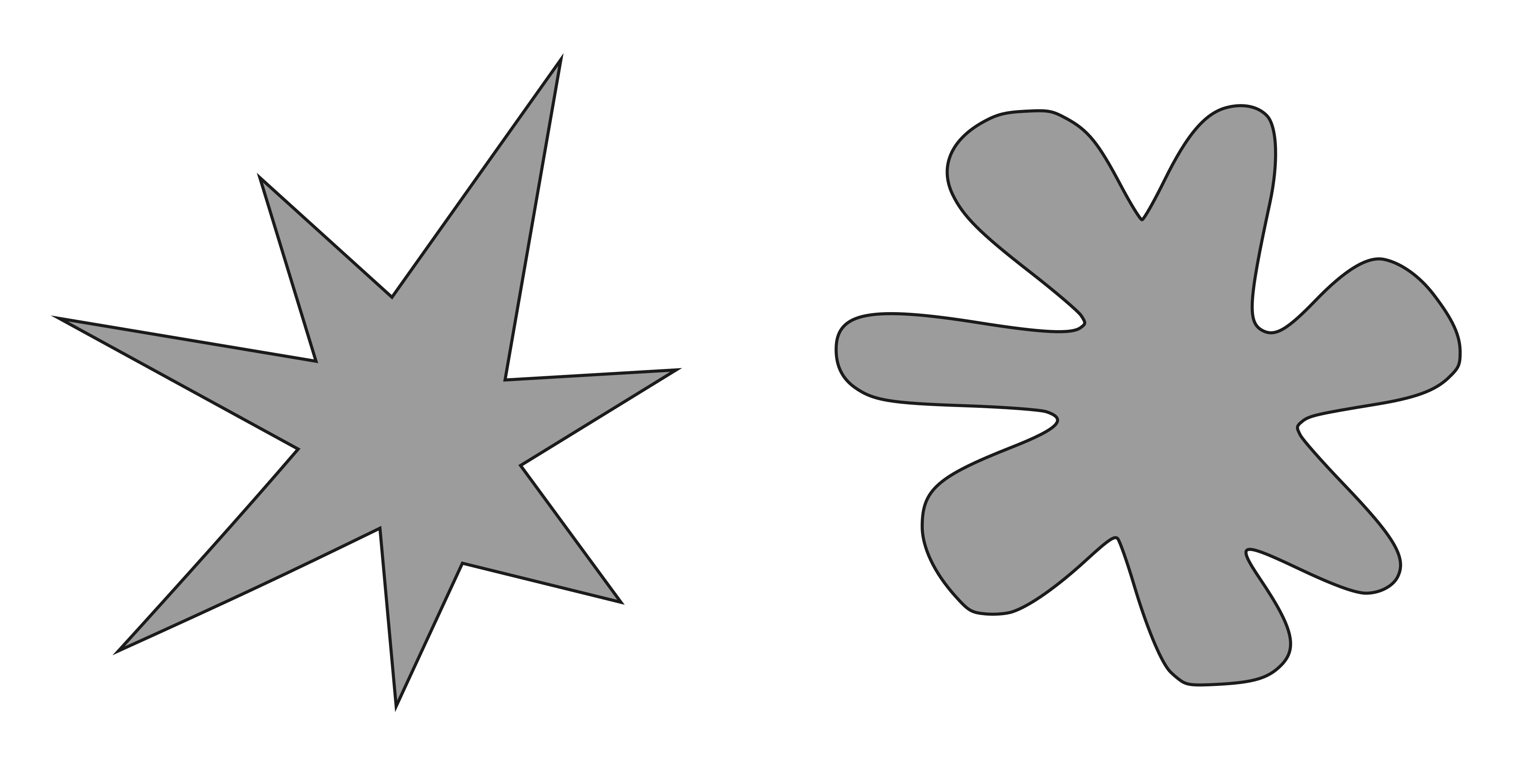
This is certainly a part of the vibe, but more as a general part of sound symbolism, the relationship between the sound of a word and what it means. What we're trying to describe certainly falls under that umbrella, but there doesn't seem to be a word for the correctness/agreement between the two.
Finally a lot of these posts end up referencing phonesthemes, where certain patterns of words are often paired with a certain meaning. As an example 'gl–' is associated with light/vision: glitter, glisten, glow, gleam, glare, glint; or '–udge' for heaviness/stickiness: pudge, fudge, sludge, grudge, trudge. There's certainly something here (these words often have the qualia we're looking for, and incongruent examples like glove and smidgen often don't have it) but again it's not complete. What describes bulbous??
Make your own answer
As far as I can tell, there is no word for this. But dictionaries are descriptive, 4 Even though everyone complains when they add looksmaxxing to the dictionary, or unc to the valid Scrabble words, it's not a value judgement. You may not like it, but people are using it! and we have a concept with no word. Let's make one up!
I'm suggesting physionym.
physionym /ˈfɪz.i.ə.nɪm/ (FIZ-ee-uh-nim)
nounA word whose sound seems naturally suited to its meaning, without imitating an actual sound. Compare onomatopoeia.
'Scintillating' is a perfect physionym: the word itself seems to sparkle.
If a word feels more like this (say ooze or acrid or discombobulates or effervescent or, yes, bulbous) then you would say it's a physionym or that it's physionymous (rhyming with anonymous).
This combines the Greek 'physis' for nature with the Greek '–onym' suffix for name 5 Technically name is ὄνυμα, with the '–onym' suffix coming from the Greek '–ώνυμον' (ōnymon). that's abundant in English today (pseudonym, acronym, homonym, etc.). This dates back to Cratylus, a dialogue by Plato on the 'correctness of naming'. Socrates speaks to this very concept, talking about the letter ρ expressing motion, and λ as smooth, concluding that "I myself prefer the theory that names are, so far as is possible, like the things named". In the native Greek this is a debate between the 'physei', where names are by nature, as opposed to 'thesei', by convention. Therefore a physionym feels apt for this very feeling.

Beauty is in the eye of the beholder
There's obviously a lot that goes into this. Some of it are the phonesthemes that I talked about higher up. Some are specific letter sounds like what Socrates mentioned: for me, an example of this is the word cloying /ˈklɔɪ.ɪŋ/, where the closing diphthong of 'oy' /ɔɪ/ into the voiced velar nasal sound of the 'ng' sound [ŋ] feels like it lingers in the back of your throat, much like things cloying describes. 6 Or the bounciness of the voiceless to voiced fricatives in the f/v in effervescent, combined with the hissed /s/ making it feel as fizzy and bubbly as the word itself.
Some of it is survivorship bias—words that 'seem right' will stick around in usage, and can outcompete less 'right' words in a process called lexical replacement (take something like zipper absolutely destroying 'hookless fastener', or airship/dirigible being outcompeted by blimp, which just feels more pudgy). Some of it's just the synesthesia of familiarity—if you're repeatedly saying a word with a concept, your brain will associate that word with that concept, and over time it will just feel more apt (this feels very true for weather words like sun or rain). This is also why when I was looking for anti-physionyms 7 There are also just words that aren't physionyms, but also aren't antiphysionyms. Something like slogan or remark isn't wrong, it's just...fine. they were easier to find in words that I was less familiar with: flocculent for 'soft', or glabrous for 'free of hair' both feel wrong. The clearest antiphysionym we thought of didn't fall into this category: lackadaisical. That word has energy!
You may disagree on a lot of these. Maybe you think corrugation has this, and maybe you don't. V thinks nonchalant is a physionym, but I don't. It's not objective—Plato wrote a whole dialogue debating it. But it is good to have a word for it.
-
I think in my mind it feels like convulse or convoluted, neither of which feel sufficiently healing. ↩︎
-
Which is guau, guau in Spanish! I wonder if dog noises in different languages depend on the most common breeds to those areas. ↩︎
-
This used to be takete–maluma, but a 2001 study used bouba and kiki and that's what's gone viral ever since. ↩︎
-
Even though everyone complains when they add looksmaxxing to the dictionary, or unc to the valid Scrabble words, it's not a value judgement. You may not like it, but people are using it! ↩︎
-
Technically name is ὄνυμα, with the '–onym' suffix coming from the Greek '–ώνυμον' (ōnymon). ↩︎
-
Or the bounciness of the voiceless to voiced fricatives in the f/v in effervescent, combined with the hissed /s/ making it feel as fizzy and bubbly as the word itself. ↩︎
-
There are also just words that aren't physionyms, but also aren't antiphysionyms. Something like slogan or remark isn't wrong, it's just...fine. ↩︎